Introduction





These instructions will help you get started with the Pocket Science Lab (PSLab) hardware and its associated applications.
WARNING: Do not use PSLab with high voltage circuits, in hazardous environments, or without appropriate supervision! |
|---|
What is PSLab?
Pocket Science Lab (PSLab) is a device that allows you to explore the world using sensors to record, analyze, and generate signals and data.
At the core is a custom circuit board containing a PIC24 microcontroller which interfaces between the physical world of electronics and sensors, and the digital world of computers (running operating systems such as Windows, macOS, or Linux) and even Android phones.
What can I do with PSLab?
“Out of the box”, PSLab can be used as an electronics workbench with a number of built-in features, including:
Desktop low-voltage power supply with three programmable voltage sources (±3.3 V, ±5 V, 0–3 V).
3-channel[1] oscilloscope with software selectable amplification stages.
Multimeter functions, including voltmeter and capacitance measurement.
Digital and analog function generators.
4-channel logic analyzer.
In addition, PSLab has several interfaces through which it can work with programmable sensors:
I2C, SPI, UART data buses.
Digital and analog I/O.
Advanced Plugins/Add-on Modules.
Support for acceleration/gyroscopes/humidity/temperature modules, etc.
See the product specifications page and datasheet for more information on features.
Entire stack
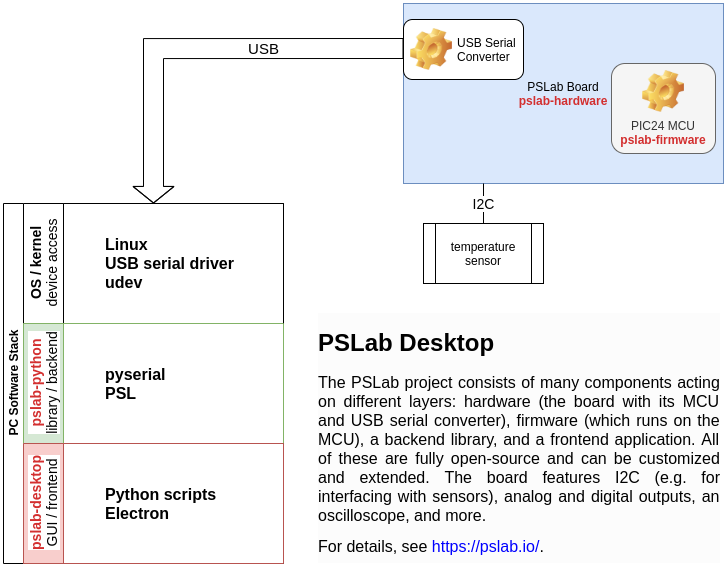
The full stack for use on desktop computers is described in this diagram:
Limited CH3 range: -3.3 V to +3.3 V; CH1 and CH2 range from -16.5 V to +16.5 V.
Lack of (software selectable) gain.